

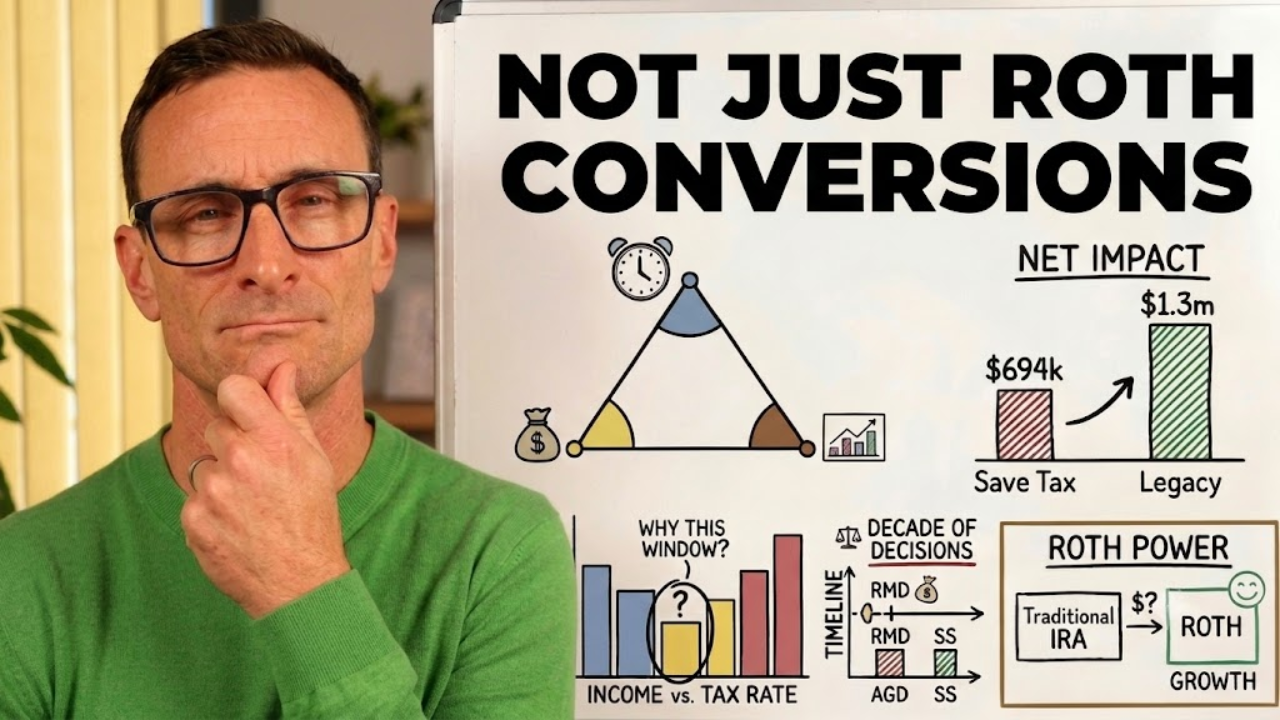
Retiring with a seven-figure IRA feels like the finish line. But without a deliberate retirement tax plan, that balance can quietly cost far more than it needs to. Consider a couple we’ll call Brad and Lisa, both 64, who retired this year with $2.3 million — most of it sitting in pretax traditional IRAs. By every conventional measure, they had done everything right. Yet without a plan, they were on track to hand the IRS roughly $694,000 more than necessary — not because of bad investments or poor decisions, but because of a tax window they didn’t know existed.
The Hidden Gap Retirement Creates
The moment you stop working, something happens automatically: no more W-2 income, no more payroll withholding, no more paycheck pushing you into a higher bracket. For a stretch of years — often a decade or more — taxable income can drop lower than it’s been since your first job out of college, and lower than it will ever be again.
This gap doesn’t last. Once Social Security starts and required minimum distributions (RMDs) begin forcing money out of tax-deferred accounts, income rises again, sometimes sharply. Most retirees never notice this window because no one points it out to them. A solid retirement tax plan is built around using it.
Why Paying Tax Now Can Beat Paying Tax Later
The logic is straightforward: paying tax at a lower rate today is better than paying it at a higher rate later. It’s the retirement-planning equivalent of stocking up before a price increase. The IRS is effectively offering a discount window — a stretch of years when the rate on IRA money is lower than it will be once Social Security and RMDs fill the picture back in.
There are two main ways to use it. The first is a Roth conversion: moving money from a traditional IRA into a Roth now, paying tax at today’s lower rate, so it grows tax-free afterward and never triggers an RMD. The second is simply taking IRA distributions at the lower rate during these years, which preserves brokerage and Roth assets longer without converting aggressively. Neither is universally “right” — the better fit depends on bracket space, health coverage needs, and personal goals.
A 2026 Complication: Health Insurance Before Medicare
For Brad and Lisa, Roth conversions are the primary strategy — with one wrinkle. Because they’re 64, they need private coverage before Medicare begins at 65, which means qualifying for ACA marketplace subsidies. Those subsidies disappear entirely once household income crosses roughly $84,600 (400% of the federal poverty level for a household of two) — a cliff that returned in 2026 after several years of expanded eligibility. So for now, conversions stay small or paused; once Medicare coverage starts, that constraint lifts and conversions can move ahead more aggressively.
Knowing Where to Stop
The instinct once you spot this window is to fill it as much as possible — but overfilling it can cost more than it saves. Two ceilings matter here. The first is IRMAA, the Medicare premium surcharge triggered by crossing certain income thresholds and calculated off income from two years earlier. The second is charitable intent: retirees who plan to give from their IRA later through tax-free qualified charitable distributions lose that benefit if they convert away the balance today.
A well-built retirement tax plan tapers conversions deliberately — up to the first IRMAA threshold, then down to a target bracket ceiling, then stops. The number that matters isn’t how much you converted; it’s how much you actually kept.
The Cost of Waiting
The riskiest move is treating this as something to handle “eventually.” Every year of delay shrinks the window, and RMDs arrive on a fixed IRS schedule regardless of readiness — for many IRA owners today, that age is 75. When RMDs begin, they stack directly on top of Social Security, pushing more of it into taxable income and filling the bracket space that could have been used deliberately years earlier. Waiting is itself a decision, and for most IRA millionaires, it’s the most expensive one they never realized they were making.
The Bottom Line
For Brad and Lisa, mapping out a full retirement tax plan — identifying the window, choosing the right strategy, and knowing exactly where to stop — worked out to roughly $694,000 less paid in taxes and $1.3 million more in net legacy. Not from earning more or taking on more risk, but from three decisions made in the right order at the right time: timing, strategy, and amount.
If you’re sitting on a large IRA, those three decisions are being made either deliberately or by default — and the default is almost always the more expensive one.
The Retirement Recap
Join the 1,000+ other retirees and get weekly articles and videos to help you retire with confidence. Subscribers also gain access to our private monthly client memo.
Seek Professional Guidance
Navigating retirement decisions can be complex. Consulting with a certified financial planner can provide personalized insights and strategies tailored to your unique circumstances. Whether you’re nearing retirement or planning ahead, expert advice can help you optimize your Social Security benefits and achieve greater financial confidence in your retirement years.
This does not constitute an investment recommendation. Investing involves risk. Past performance is no guarantee of future results. Consult your financial advisor for what is appropriate for you. Disclosures: https://onedegreeadvisors.com/disclosure/