

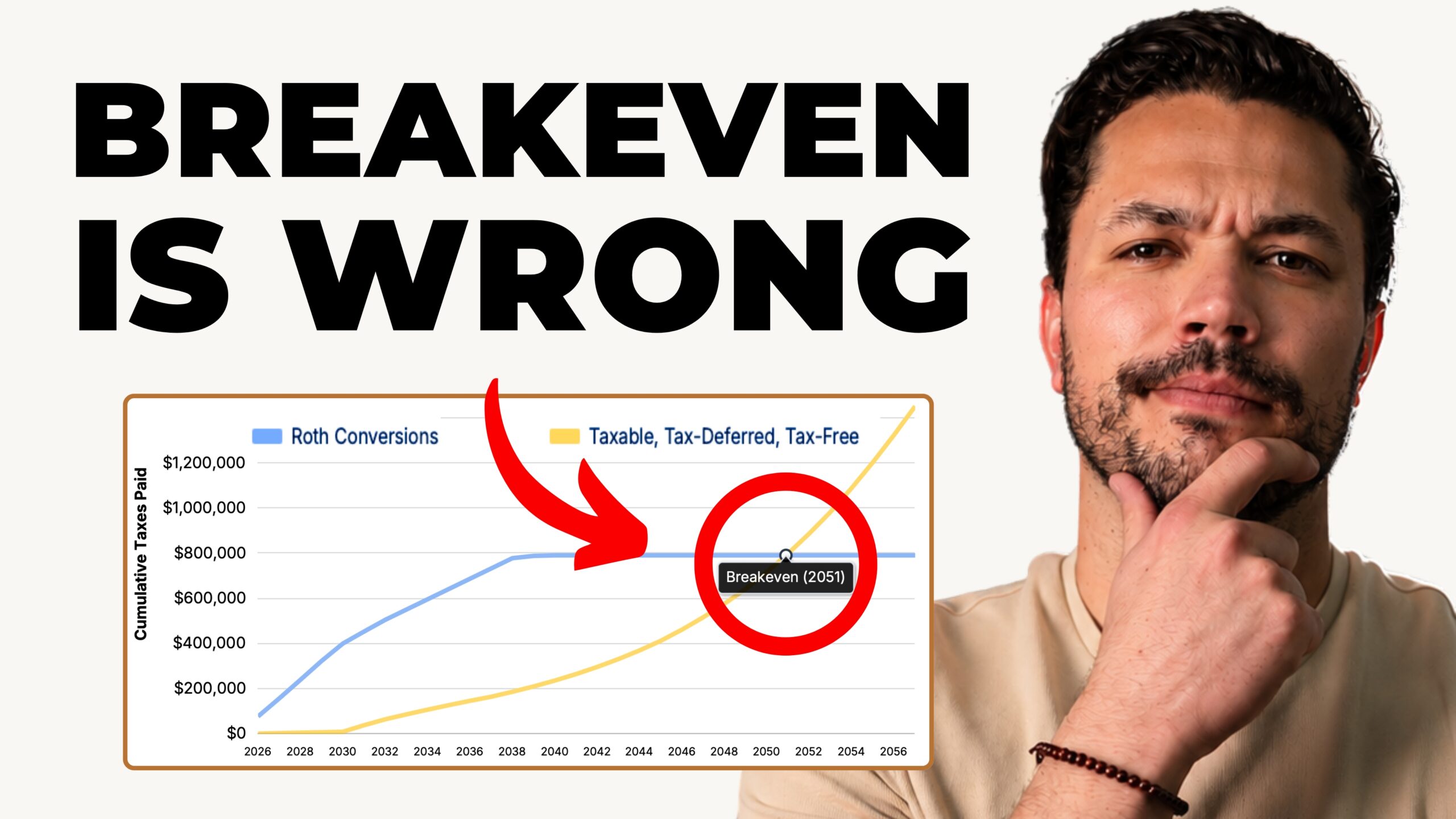
If your advisor has ever shown you a chart with two lines converging at some date in your 80s, you’ve seen the standard case for a Roth conversion. It looks precise. It looks like math. And for most people weighing a Roth conversion break-even date, it’s the only tool they’re ever given to decide whether converting makes sense.
The problem is that the chart isn’t actually measuring what most people think it’s measuring — and treating it as the deciding factor can cost a household hundreds of thousands of dollars, particularly after one spouse passes away.
Two Camps, One Mistake
Most people who look at a break-even chart land in one of two places. The first group freezes. They see a crossing point in their mid-80s, decide there’s no way to know if they’ll live that long, and shelve the decision entirely. The second group converts anyway — not because they ran the numbers, but because “tax-free” sounds appealing and they’ve heard other people are doing it.
Both groups skip the one variable that actually drives the outcome: the spread between your tax rate today and your tax rate in retirement.
A Simple Example That Undercuts the Chart
Consider converting $200,000 from a traditional IRA, paying the 20% tax bill directly out of the IRA. That leaves $160,000 moving into the Roth, growing at 8% for ten years to roughly $345,000 — all of it usable, tax-free.
Now compare that to leaving the $200,000 in the traditional IRA. Over the same ten years at 8%, it grows to about $432,000. But it’s still a traditional IRA, so withdrawing it at the same 20% tax rate leaves you with roughly $345,000 — the identical after-tax result.
When your tax rate is the same at conversion and at withdrawal, the order in which you pay taxes doesn’t change your outcome. Which raises the obvious question: if both paths land in the same place, what is the break-even chart even counting down to?
The answer is: nothing, in the sense most people assume. Converting doesn’t create a new tax bill — it settles one the IRS already had a claim on. There is no “recovery period” to wait out. The result is locked in the moment you know whether your future tax rate will be higher, lower, or the same as today’s. If it’s higher later, converting now wins immediately. If it’s lower later, converting loses, and no amount of time changes that. Life expectancy never enters the equation.
The Two Real Costs That Do Matter
None of this means the break-even date is pure fiction. Two real costs sit underneath it, and they’re worth understanding.
- How you pay the tax. If covering the conversion means selling appreciated stock, you’ve triggered a capital gain that wouldn’t have existed otherwise — real money leaving your balance sheet.
- IRMAA. A conversion spikes your modified adjusted gross income for the year, and two years later, Medicare premiums can rise as a result.
Both are real, but they function more like a toll booth than a verdict on the strategy itself. The toll costs something, but it has nothing to do with whether the destination — a lower lifetime tax bill — is worth reaching. On any conversion of meaningful size, that toll is usually the smaller number in the equation.
Testing the Chart Against Real Numbers
Take a hypothetical couple, Thomas (64) and Sally (63), recently retired in California with $2.4 million in traditional IRAs and $800,000 in a brokerage account. Two conversion strategies are modeled against the same plan: one fills the 12% tax bracket every year, the other fills the 22% bracket.
The 12%-bracket strategy breaks even in 2048. The 22%-bracket strategy doesn’t break even until 2051 — three years later. If the break-even date meant what most people assume, the faster strategy would win.
It doesn’t. In this modeled scenario, the strategy that breaks even in 2048 leaves the family roughly $547,000 ahead. The one that breaks even three years later leaves them roughly $1.1 million ahead — nearly double, despite crossing the line later. The only thing that changed was how much they converted. Convert more, and the non-conversion comparison line simply has further to travel before it catches up — pushing the crossing point later even as the strategy performs better. The break-even date measures how aggressive the conversion was, not whether it worked.
What If One Spouse Dies Early?
The real reason most people fixate on a break-even date is fear: what if I convert and don’t live long enough to see the benefit? Modeling this directly changes the picture entirely.
In the same plan, if Thomas passes away at 75 — seven years before either break-even point — the household’s lifetime average tax rate (assuming both had lived to 95) would have been roughly 17.1% with no conversions. With Thomas gone at 75, that rate rises to roughly 24.5%. Sally doesn’t get richer when Thomas dies; she loses a Social Security check and, as a single filer, moves into a tax structure where brackets are roughly half as wide as a married couple’s. In 2026, for example, a married couple stays in the 22% bracket up to $211,400 of taxable income, while a single filer at that same income level is already in the 32% bracket.
This is the widow’s penalty, and it isn’t subtle. Under this scenario, the 12%-bracket conversion strategy — worth $547,000 when both spouses lived to 95 — becomes worth roughly $1.4 million when Thomas dies early. The 22%-bracket strategy goes from $1.1 million to roughly $1.5 million. Converting became more valuable in exactly the scenario people fear most, because it left the surviving spouse holding a Roth account instead of a traditional IRA that would otherwise generate taxable distributions as a single filer for the rest of her life.
The Real Takeaway
The break-even chart was never answering the right question. It measures the speed of a comparison, not the quality of a decision — and in the scenario most people are actually afraid of, it points in exactly the wrong direction.
If you’re approaching your 70s with a large IRA balance, required minimum distributions are coming whether you plan for them or not, and the window to convert strategically narrows every year you wait. The decision isn’t about finding a date where two lines cross. It’s about identifying the tax-rate spread that actually exists between now and later — and building a conversion strategy around that, with a clear eye on what happens to a surviving spouse if the plan doesn’t get the full timeline it was built for.
The Retirement Recap
Join the 1,000+ other retirees and get weekly articles and videos to help you retire with confidence. Subscribers also gain access to our private monthly client memo.
Seek Professional Guidance
Navigating retirement decisions can be complex. Consulting with a certified financial planner can provide personalized insights and strategies tailored to your unique circumstances. Whether you’re nearing retirement or planning ahead, expert advice can help you optimize your Social Security benefits and achieve greater financial confidence in your retirement years.
This does not constitute an investment recommendation. Investing involves risk. Past performance is no guarantee of future results. Consult your financial advisor for what is appropriate for you. Disclosures: https://onedegreeadvisors.com/disclosure/