

Most people approaching retirement have some version of the same worry: “I think we have enough, but I don’t know how to tie it all together.” A strong retirement spending plan doesn’t start with a portfolio number — it starts with the life someone wants to fund, and then works backward to figure out how to pay for it responsibly.
That’s exactly the process behind one couple’s plan — we’ll call them Mike and Molly, both 64 and retiring at the end of this year. Their situation offers a useful, real-world look at how a retirement spending plan actually comes together: not as a single withdrawal percentage, but as a system built from spending goals, Social Security timing, market safeguards, tax strategy, and investment structure working together.
Meet Mike and Molly: Defining the Goal First
Mike and Molly have three kids, five grandkids, and a clear picture of what they want retirement to look like. Travel and family experiences top their list — not as a handful of big trips early on, but as a permanent line item in their spending for as long as they’re able. Charitable giving, particularly around youth and education, is their other major priority, and it shapes their tax strategy directly.
That distinction matters. A retirement spending plan built around occasional splurges looks very different from one built around ongoing, permanent spending categories — and it changes how the whole plan needs to be structured.
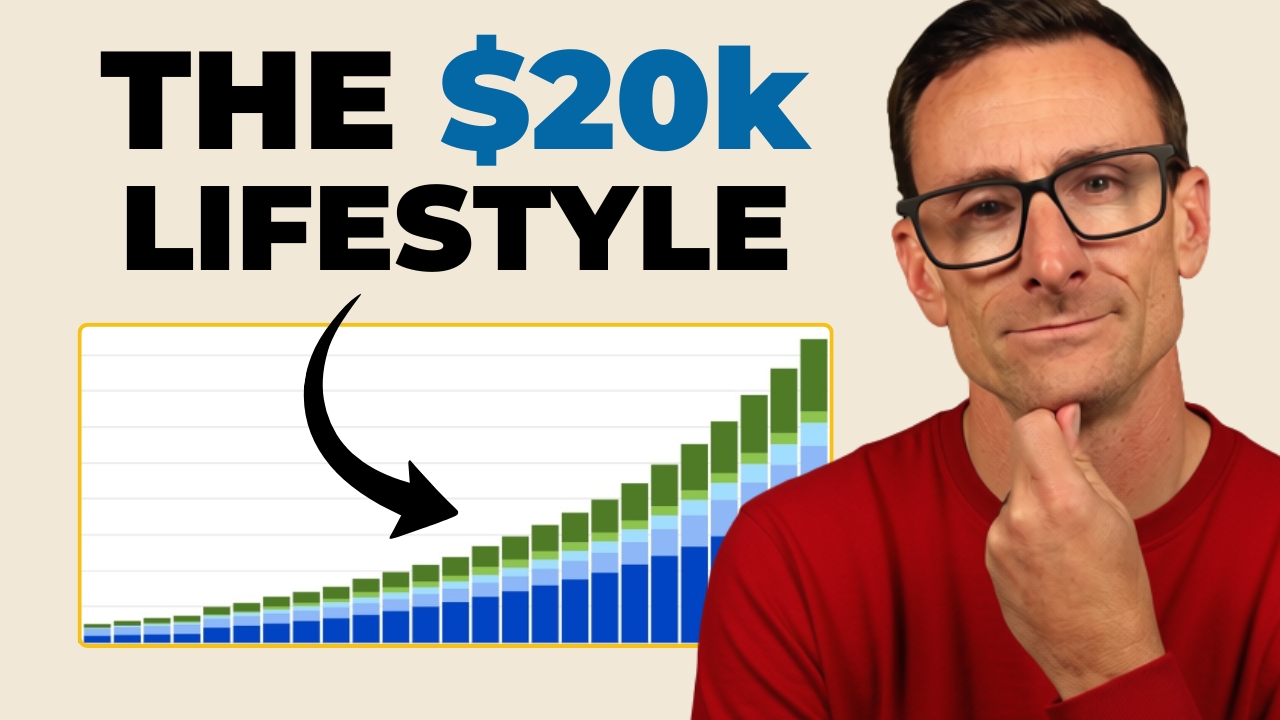
Setting the Number: How $20,000 a Month Was Determined
When Mike and Molly sat down to define their needs, their monthly requirement came out to $18,000: $14,000 in core living expenses, $2,500 for travel and experiences, and $1,500 for giving. But because they were making the leap from building wealth to living on it for the first time, they wanted a target that felt comfortable, not just technically sufficient. They landed on $20,000 a month — a $2,000 monthly cushion built in from the start.
That cushion becomes important later, when the plan needs to absorb a rough market stretch without forcing an immediate lifestyle change.
Do They Actually Have Enough?
Here’s what they’re working with: Mike’s 401(k) sits just under $2 million, Molly’s 401(k) is at $1.1 million, Molly’s Roth IRA holds $505,000, their joint brokerage account is at $410,000, and they have $110,000 in cash. With ongoing contributions through year-end, their total lands around $4 million — with 78% sitting in pretax accounts, which makes tax strategy essential rather than optional.
Running the math, $20,000 a month is $240,000 a year — roughly a 6% withdrawal rate on a $4 million portfolio. That’s well above the commonly cited 4% rule, which can look alarming on its own. But the 4% rule doesn’t account for Social Security reducing the load on the portfolio, a tax strategy that changes how much of each withdrawal is actually kept, or a guardrail system that adjusts spending based on how the portfolio performs. The 4% rule is a reasonable starting point — the combination of these other levers is what actually makes a retirement spending plan work at a higher withdrawal rate.
Social Security: Timing as a Planning Lever
If both Mike and Molly live into their mid-90s, the math favors both deferring Social Security to age 70. But the plan was also modeled against Mike passing earlier, around age 84 — a scenario where Molly’s claiming decision shifts closer to their retirement date. What stays constant across both scenarios is Mike deferring to 70, since he has the higher benefit; maximizing it protects Molly as the survivor, because she steps up to his benefit if he passes first.
Molly, meanwhile, has more flexibility. She plans to start benefits at 67 (her full retirement age), but that’s not locked in — a rough market stretch early on could push her to start sooner, while a strong stretch could let her defer longer.
In practice, this creates what’s often called a “hatchet shape”: the portfolio carries the full $20,000 a month early in retirement, before Social Security kicks in, then tapers as benefits phase in over time.
Guardrails: Planning for What the Market Actually Does
Because the portfolio carries the heaviest load in the early years, the plan needs a built-in response for market volatility — that’s where a guardrail system comes in. Instead of picking a fixed withdrawal amount and hoping it holds up, guardrails set pre-agreed boundaries for when and how much spending adjusts.
For Mike and Molly: if the portfolio grows to $6.9 million, spending increases by $10,600 a month. If it drops to around $2.4 million, spending adjusts down by $800 a month — drawing from their built-in cushion first, rather than forcing an immediate cut to their $18,000 baseline.
To pressure-test this, the plan was run against the 1968–early 1980s stretch — the worst sustained inflation period in modern U.S. history. Even through that period, the portfolio never touched the lower guardrail, and as markets recovered, the plan actually triggered upward spending adjustments while keeping pace with inflation.
The Tax Strategy: The “Tax Valley” and Roth Conversions
With 78% of their portfolio in pretax accounts, every dollar withdrawn from those 401(k)s is taxed as ordinary income. Without a deliberate strategy, Mike and Molly were projected to overpay the IRS by roughly $322,000.
The opportunity is what’s sometimes called the “tax valley” — the first two years of retirement, after work income ends but before Social Security and required minimum distributions begin, when taxable income drops to its lowest point in decades. During this window, the plan uses Roth conversions: moving money from pretax accounts into Roth accounts, paying tax now at a lower rate, so it can grow and eventually come out tax-free.
A pure optimizer would convert aggressively — all the way to the top of the IRMAA threshold. But once Mike and Molly turn 70½, they can use qualified charitable distributions (QCDs) to send money from their IRA directly to causes they support, completely tax-free. Converting too aggressively now means paying tax today on dollars that could have come out tax-free later through QCDs — so the plan pulls back, converting only up to the 22% tax bracket in those early years.
There’s a real trade-off to account for: those conversions push income high enough in 2027 to land in a higher Medicare IRMAA bracket, meaning higher premiums temporarily. By 2030, once the heavy conversion years are behind them, income is expected to settle back into a lower bracket. (For those not yet on Medicare, the same tax valley strategy applies — but aggressive conversions can instead push income above ACA subsidy thresholds, so the full cost picture matters either way.)
The net result: a projected $322,000 in tax savings, a $1 million increase in projected net legacy, and a smoother tax curve over time.
Structuring the Investments to Support the Plan
The final piece of the retirement spending plan is how the portfolio itself is invested. Decades of growth-focused investing often need to shift once someone starts living off the money — not abandoning growth, but making sure the right money is in the right place at the right time.
For Mike and Molly, that means keeping roughly four years of withdrawals — about 23% of the portfolio — in cash and high-quality bonds, giving the stock portion time to recover from any downturn without being forced to sell at the wrong moment. The remaining 77% stays in stocks for long-term growth. Within that structure, each account plays a specific role: the brokerage account (the first source of withdrawals) is positioned moderately for some stability, Molly’s Roth IRA — with the longest time horizon — is invested 100% in stocks, and their 401(k)s, which will roll into IRAs at retirement, are positioned for moderate-to-growth allocations depending on when each is likely to be tapped.
The Real Question Behind “Do We Have Enough?”
Mike and Molly came in already having heard “yes” from people around them. But yes isn’t a plan. What they actually wanted to know was whether their tax strategy, spending, and investments were all working together — or whether they were unknowingly leaving money on the table.
That’s the more useful question for anyone building a retirement spending plan: not just “do I have enough,” but does the plan show exactly how the portfolio becomes income, what it costs in taxes, and how it holds up when markets don’t cooperate. If the answer to any of those three isn’t clear, that’s worth a real conversation — not just a gut-check number.
The Retirement Recap
Join the 1,000+ other retirees and get weekly articles and videos to help you retire with confidence. Subscribers also gain access to our private monthly client memo.
Seek Professional Guidance
Navigating retirement decisions can be complex. Consulting with a certified financial planner can provide personalized insights and strategies tailored to your unique circumstances. Whether you’re nearing retirement or planning ahead, expert advice can help you optimize your Social Security benefits and achieve greater financial confidence in your retirement years.
This does not constitute an investment recommendation. Investing involves risk. Past performance is no guarantee of future results. Consult your financial advisor for what is appropriate for you. Disclosures: https://onedegreeadvisors.com/disclosure/