

You did everything right. You saved consistently, invested wisely, and stayed the course through market cycles. So why does the idea of actually spending that money in retirement still feel risky?
For many people approaching retirement with $3 million or more in savings, the anxiety isn’t about whether they’ve saved enough — it’s about whether they’re allowed to actually use it. A well-built $3 million retirement plan already accounts for the risks that keep people up at night, and understanding how it does that can unlock more spending, not less, in the years when it matters most.
Retirement Spending Doesn’t Move in a Straight Line
Most retirement plans are built around a simple, flawed assumption: that spending stays flat, adjusted only for inflation, for 30 years straight. Real life doesn’t work that way.
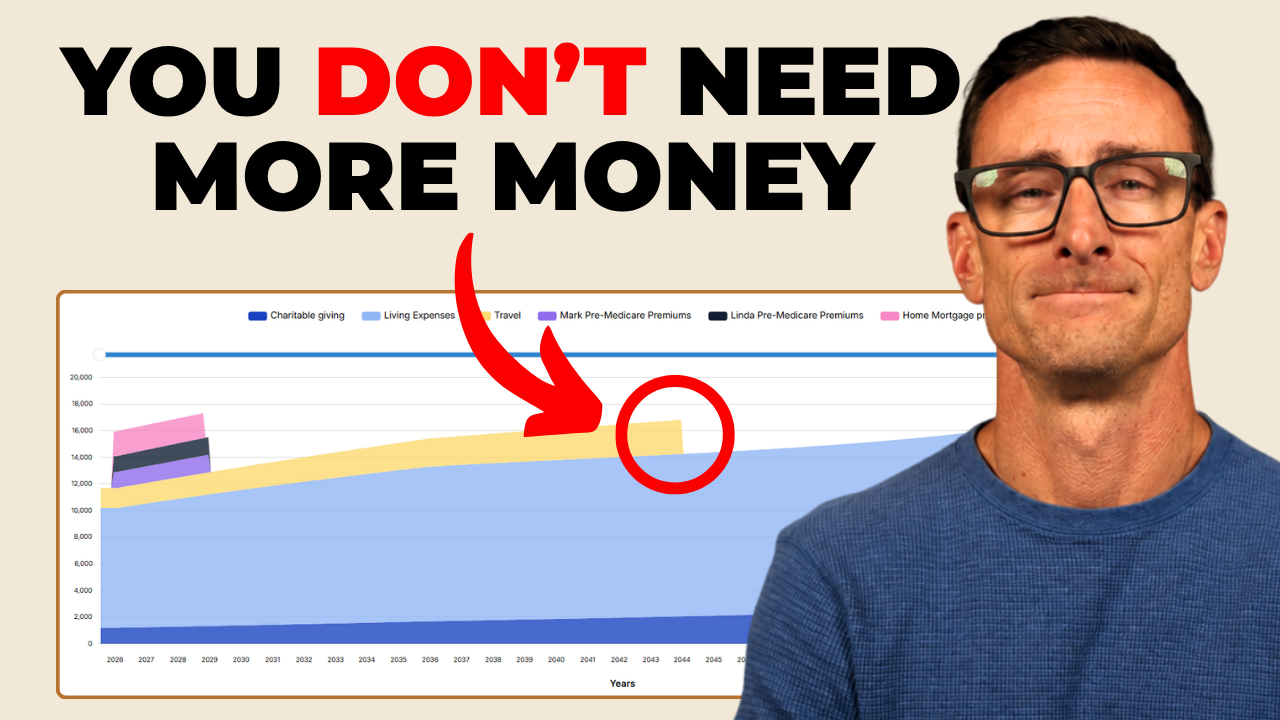
David Blanchett, formerly head of retirement research at Morningstar, spent years studying what retirees actually spend — not what planners assumed they’d spend, but real patterns drawn from thousands of retiree households. What he found looks nothing like a flat line. It looks like a smile.
- Early retirement (60s into early 70s): Spending tends to run higher. You’re healthy, active, and finally doing the things you spent decades planning for.
- Middle retirement: Spending naturally pulls back as that high-activity phase eases.
- Later retirement: Spending nudges back up, driven primarily by health care costs.
It’s important to be clear about what “pulling back” means here. This isn’t about smaller deposits landing in your account — your income can stay flat or rise with inflation just fine. What actually declines is real purchasing power, as spending habits shift with lifestyle changes in the middle years.
Factoring in this pattern, instead of assuming flat spending, can reduce the total savings a retiree needs by an estimated 15% to 25%, and can support initial spending rates roughly 20% higher than traditional flat-line models suggest. On a plan that a flat-line model says supports $8,000 a month, the smile-adjusted version might support closer to $9,600 a month in the years you’re most likely to want it.
For some people, that gap isn’t just about spending a little more. It’s the difference between retiring now and working two or three more years they didn’t actually need to work. When a plan is built on an inaccurate assumption, the cost shows up exactly in the years holding back costs the most.
Why the 4% Rule Isn’t Built for a Coordinated Plan
The spending smile is only half the picture. Most retirees pair a flat spending assumption with a single, static withdrawal rule — most commonly, the 4% rule. On its own, the 4% rule isn’t a bad rule. It’s simply being applied in a situation it was never designed for.
Think of it like navigating with a paper map. The map isn’t wrong — the roads are real and the distances are accurate. But it can’t account for what changes along the route: a traffic jam, a road closure, a faster path that opens up. GPS with live traffic doesn’t replace the map because the map was wrong. It replaces it because the map was built for something static, and the real drive is dynamic.
That’s exactly what happens when the 4% rule gets applied to a coordinated retirement plan. The rule assumes a portfolio withdrawing at the same rate every single year, with no allowance for income sources that start up or expenses that drop off along the way. Real retirement rarely looks like that:
- A mortgage gets paid off, and the $2,500 a month that went to the bank stays in your pocket.
- A pension starts at 65, or Social Security comes online.
Each of these events changes what the portfolio actually needs to produce — but the 4% rule treats every year the same regardless.
The Income “Hatchet” Pattern
This is where a pattern known as the income hatchet comes in, and it shows up often in well-coordinated retirement plans for good reason. Withdrawals run higher in the early years, then taper naturally as other income sources — Social Security, a pension, a paid-off mortgage — layer in and reduce what the portfolio needs to cover.
That early period matters enormously. Research shows that the compounded return in the first decade of retirement can account for roughly 77% of the final portfolio outcome. The reason comes down to sequence of returns risk.
Consider two hypothetical retirees, each starting with $1 million in a 50/50 stock-and-bond allocation, each withdrawing at a 5% initial rate with 3% annual increases. The only difference is the year they retire. A retiree who happens to retire right before a market downturn can see a portfolio depleted years earlier than someone who retires with even a single year’s difference in timing — despite identical savings, identical allocation, and identical withdrawal strategy. The order in which returns arrive, not just their average over time, determines the outcome — especially when withdrawals are happening at the same time as the losses.
A coordinated plan has to account for that vulnerability on purpose. One of the most effective ways to do it is by letting Social Security grow. Delaying a Social Security claim from age 62 to 70 can mean roughly 77% more in monthly income, based on a full retirement age of 67. That’s a meaningful income layer once it kicks in, and it changes what the portfolio needs to produce from that point forward.
The key is not letting a static withdrawal rule force the decision. If a rigid 4% cap says you can’t afford to wait on Social Security, you may feel pressured to claim early just to make the math work in the short term — even when a coordinated plan, built around a higher early withdrawal rate specifically so you can afford to wait, produces a stronger outcome overall. The same logic applies to a pension starting at a set age or a mortgage clearing in a few years. Real life isn’t a straight line, and a retirement plan shouldn’t treat it like one.
The “War Chest”: Protecting the Plan When Markets Don’t Cooperate
Understanding sequence of returns risk and having a mechanism to actually handle it are two different things. That mechanism is often referred to as a war chest.
Think of it like a home generator. You hope you never need it. But when the power goes out, you’re not scrambling, because it’s been sitting on standby with a specific job to do.
Bear markets aren’t rare. They happen on average every three and a half years and typically take around two and a half years to recover. But the longer ones — extended downturns and recovery periods measured in years rather than months — put retirees in the same painful bind: sell stocks at a loss to fund income, or cut spending. Neither is a good option, and either one can permanently damage a portfolio’s ability to recover.
A war chest is built specifically to eliminate that choice. It’s constructed from cash and short-to-intermediate-term, high-quality bonds — stable by design, and sized to cover income needs during exactly the kind of downturn that would otherwise force a bad decision. Short-term bonds mature quickly and generally carry less interest rate risk than long-term bonds, and the high-quality component minimizes default risk. The idea is to take risk where it’s historically been rewarded — in stocks — and minimize it exactly where stability matters most.
How large should a war chest be? Typically somewhere in the range of three to seven years of income needs, though that range should flex based on your own risk tolerance and comfort level. Someone who sleeps fine through a down market might size it toward the lower end. Someone who wants maximum peace of mind sizes it toward the higher end. What matters isn’t the exact number — it’s that the war chest exists, and that it’s sized to bridge the gap without forcing you to touch the growth portfolio at the worst possible time.
The Guardrail System: How Much Can You Actually Spend?
The war chest handles the market side of the equation — what happens when returns go against you. But there’s one more layer that determines how confidently you can actually spend: the guardrail system.
Underneath all of this sits a question most retirees never get a clean answer to: how much can I actually spend? Not in theory, not based on a rule of thumb, but in a plan that adjusts with reality as it unfolds.
A static withdrawal rule — the traditional 4% rule, or the more conservative rates some research points to as sustainable under a fixed approach — creates a hard ceiling. The only way to stay “safe” is to stay under it. The problem is that the ceiling exists because the plan never adjusts. It has no way to respond to the fact that Social Security will eventually kick in, that a mortgage will get paid off, or that the burden on the portfolio will look completely different in ten years than it does on day one.
A dynamic guardrail system works differently. Instead of locking in one fixed withdrawal rate and hoping it holds for 30 years, it establishes upper and lower boundaries that trigger small, pre-agreed adjustments based on what the portfolio is actually doing. Because the plan can adjust in both directions, it can typically afford to start from a higher initial withdrawal rate than a static rule would allow.
What This Can Look Like on a $3 Million Portfolio
Here’s a simplified illustration of how a guardrail system might respond in practice on a $3 million portfolio:
- If markets perform well and the portfolio grows meaningfully above its starting value, monthly spending could increase by a notable percentage.
- If markets underperform and the portfolio declines, monthly spending adjusts downward — but typically by a much smaller percentage than the upside adjustment.
That asymmetry is worth sitting with. The upside adjustment tends to be meaningful. The downside adjustment tends to be modest. It’s important to note that any specific numbers are just one illustration of how a guardrail system can work — they aren’t a universal output. Your actual starting withdrawal rate, spending levels, and adjustment thresholds would be customized to your full financial picture. The point isn’t the exact rate. It’s that the plan is built around you, not a generic ceiling applied to everyone.
A guardrail system doesn’t just make spending feel safer — it’s designed to support both a higher initial withdrawal rate and, in many cases, a stronger probability of not running out of money compared to a static rule. But beyond the numbers, it offers something a fixed rule never can: a plan that moves with reality, inside pre-agreed boundaries, so spending decisions never have to be made in a panic.
Bringing It All Together
A $3 million retirement plan, done right, already accounts for the risks you’ve spent years managing around: the spending smile, the income hatchet, the war chest, and the guardrail system. These aren’t four separate ideas bolted together. They’re one coordinated system that changes what retirement actually looks like day to day.
Think of it like a new car with features you don’t have to use every day — but it’s worth knowing what’s there, because the features you don’t know about are the ones you’ll never use.
The Retirement Recap
Join the 1,000+ other retirees and get weekly articles and videos to help you retire with confidence. Subscribers also gain access to our private monthly client memo.
Seek Professional Guidance
Navigating retirement decisions can be complex. Consulting with a certified financial planner can provide personalized insights and strategies tailored to your unique circumstances. Whether you’re nearing retirement or planning ahead, expert advice can help you optimize your Social Security benefits and achieve greater financial confidence in your retirement years.
This does not constitute an investment recommendation. Investing involves risk. Past performance is no guarantee of future results. Consult your financial advisor for what is appropriate for you. Disclosures: https://onedegreeadvisors.com/disclosure/