

For decades, Vanguard’s message to investors has been simple: buy low-cost index funds and stay invested. So many retirees were surprised when new Vanguard research on retirement income made a case for income annuities.
The paper, Vanguard’s Principles for Retirement Income, is worth reading closely. Most of its guidance is advice we’d give our own clients. One recommendation, though, deserves more scrutiny before you act on it, because getting it wrong can be expensive.
Mistake #1: Holding Too Much Cash
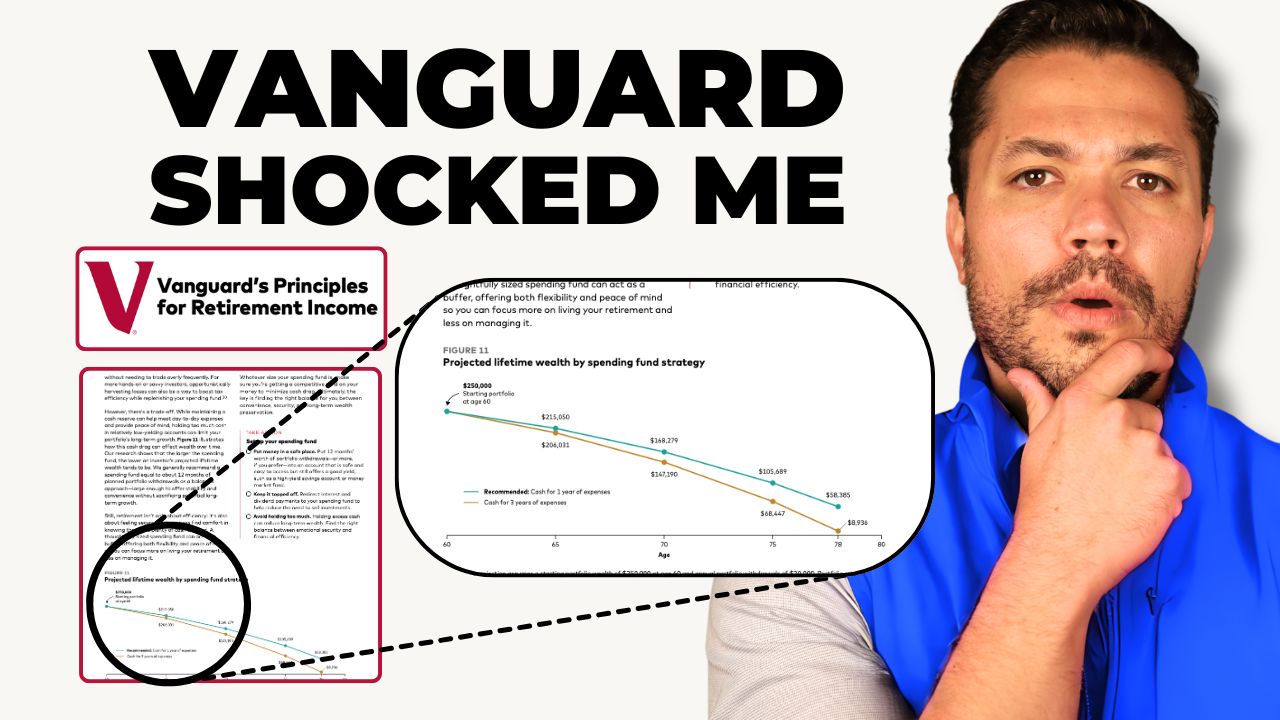
Too many retirees are holding far more cash than they should. It’s easy to understand why. Once your paycheck stops, watching your portfolio swing up and down every day can be frightening and exhausting. Cash doesn’t do that, so it feels safe.
Vanguard’s report makes it clear that this sense of safety costs more than you might think. The effect may not be noticeable in a single year, but the report shows that too much cash drags down long-term performance. Over a 30- or 40-year retirement, that drag compounds into a serious problem.
In 2026, this is happening more and more. Many investors got burned by bonds when interest rates rose, and now retirees are stockpiling cash instead.
Most retirees who hold too much cash aren’t being irrational. They simply don’t have a system. Without a clear income plan, cash becomes a security blanket by default.
Here’s the straightforward structure we use with our clients:
- About 12 months of planned spending in a money market fund, so it’s liquid, accessible, and there when you need it
- Another 2 to 6 years in high-quality, short-term bonds to replenish that reserve as it’s spent
- Everything else stays invested in the market, doing the work it’s supposed to do
This layered structure is what lets you stop hoarding cash, because now you have an income system. Vanguard’s paper makes the same recommendation.
Mistake #2: Relying on a Fixed Withdrawal Rate
For decades, the 4% rule has been the cornerstone of retirement planning. The new Vanguard research suggests it may be too aggressive and recommends pulling back to 3.5% in some cases.
The reasoning makes sense on the surface. Your withdrawal rate may be the single most important number in your retirement plan, because it determines whether your money lasts 20 years or 40. Getting it wrong doesn’t just mean tightening your budget. It could mean running out of money.
The problem is that any fixed withdrawal rate ignores the biggest variable in retirement: the sequence of returns you actually experience.
Take two retirees with the same portfolio size, the same fixed withdrawal rate, and the same everything, except that one retired in 1966 and the other in 1986. One runs out of money. The other ends up with more than they started with. The only difference was when they retired, and nobody knows in advance what returns they’ll get in the early years of retirement.
To its credit, Vanguard walks this back later in the paper and acknowledges that a dynamic spending plan is the better solution. Your withdrawal rate shouldn’t be fixed. It should move with your plan and your portfolio.
We solve this with dynamic, risk-adjusted guardrails that account for the timing of different income streams. For example, you might withdraw a higher percentage in the early years of retirement, before other guaranteed income begins. You know exactly what your monthly income can be and when adjustments need to happen. That’s very different from picking 3.5% and hoping for the best.
Mistake #3: Skipping Roth Conversions
This mistake may cost retirees more than almost any other. Vanguard found that more than 80% of retirees could benefit meaningfully from Roth conversions. In our experience, more than 80% of retirees aren’t doing them, which means many people are setting themselves up to pay more in lifetime taxes than they need to.
Why do people skip them? Almost always because of the break-even calculation. People figure out how many years it will take to recoup the taxes they pay upfront, and if the answer seems too long, they decide it isn’t worth it. That’s the wrong way to think about it.
Here’s a simple example. A married couple converts $200,000 from an IRA at a 20% tax rate. They pay $40,000 to the IRS from the IRA itself and move $160,000 into a Roth. Assuming a non-guaranteed 8% growth rate over ten years, that Roth could be worth about $345,000.
Now suppose they leave the $200,000 alone instead. Over the same ten years at the same 8%, it could grow to about $432,000. But the money is still in a traditional IRA, so at 20% on the way out, they keep about $345,000.
It’s the same after-tax result, even though the IRA grew larger. When your tax rate is identical at conversion and at withdrawal, the order in which you pay doesn’t change the outcome, and there is no break-even point.
Break-even calculations also ignore what happens to your spouse, your estate, and the tax bracket your heirs will face when they inherit a multimillion-dollar IRA.
The right question isn’t how long you’ll live. It’s whether your tax rate is lower now than it will likely be later: when required minimum distributions begin, when Social Security gets taxed, and when a surviving spouse starts filing single. For many people, the right answer is to convert, even if the break-even doesn’t work on paper.
Where We Part Ways: Vanguard on Annuities
The new Vanguard research is now promoting annuities as a retirement income solution, with charts and data to back it up.
Its argument isn’t irrational. Many retirees fear that they’ll hand over a lump sum, die early, and lose it all. Vanguard says that fear is overblown when weighed against the real catastrophic risk: outliving your money entirely.
That’s a fair point, but we still disagree, for four reasons.
- Flexibility. Money moved into an immediate income annuity, like the single premium immediate annuity (SPIA) discussed in the paper, is typically gone. You can’t access it for a medical emergency, a home repair, or to help a child through a tough spot. Most people don’t want to say no to things in life because they’re on a fixed monthly income.
- Inflation. Many annuities don’t include an inflation rider. The payment you count on in year one can be worth far less by year 15, and over a 30-year retirement that can badly erode your purchasing power.
- Guarantees. Annuities aren’t as guaranteed as most people assume. They’re backed by insurance companies and subject to insurance limits, which could leave you exposed in a serious financial crisis. We’ve also seen many clients whose insurers kept trying to buy them out, or whose policies were sold to a different company.
- Performance. When we run projections for our clients, we often find that staying invested in a well-structured portfolio outperforms what an annuity would have paid over the same period. That’s not a guarantee, but it’s what our analysis typically shows.
The Bottom Line on the New Vanguard Research
Vanguard gets three of four things right. If you’ve saved a few million dollars, its points on cash, spending flexibility, and Roth conversions are all worth taking seriously.
On annuities, we think Vanguard has overcorrected. With a proper income plan in place, you don’t necessarily need to hand over a lump sum to solve the longevity problem. Instead, focus on building a reliable income system: a right-sized cash reserve, a bond buffer, a flexible withdrawal strategy, and a tax plan that looks beyond break-even math.
The Retirement Recap
Join the 1,000+ other retirees and get weekly articles and videos to help you retire with confidence. Subscribers also gain access to our private monthly client memo.
Seek Professional Guidance
Navigating retirement decisions can be complex. Consulting with a certified financial planner can provide personalized insights and strategies tailored to your unique circumstances. Whether you’re nearing retirement or planning ahead, expert advice can help you optimize your Social Security benefits and achieve greater financial confidence in your retirement years.
This does not constitute an investment recommendation. Investing involves risk. Past performance is no guarantee of future results. Consult your financial advisor for what is appropriate for you. Disclosures: https://onedegreeadvisors.com/disclosure/