

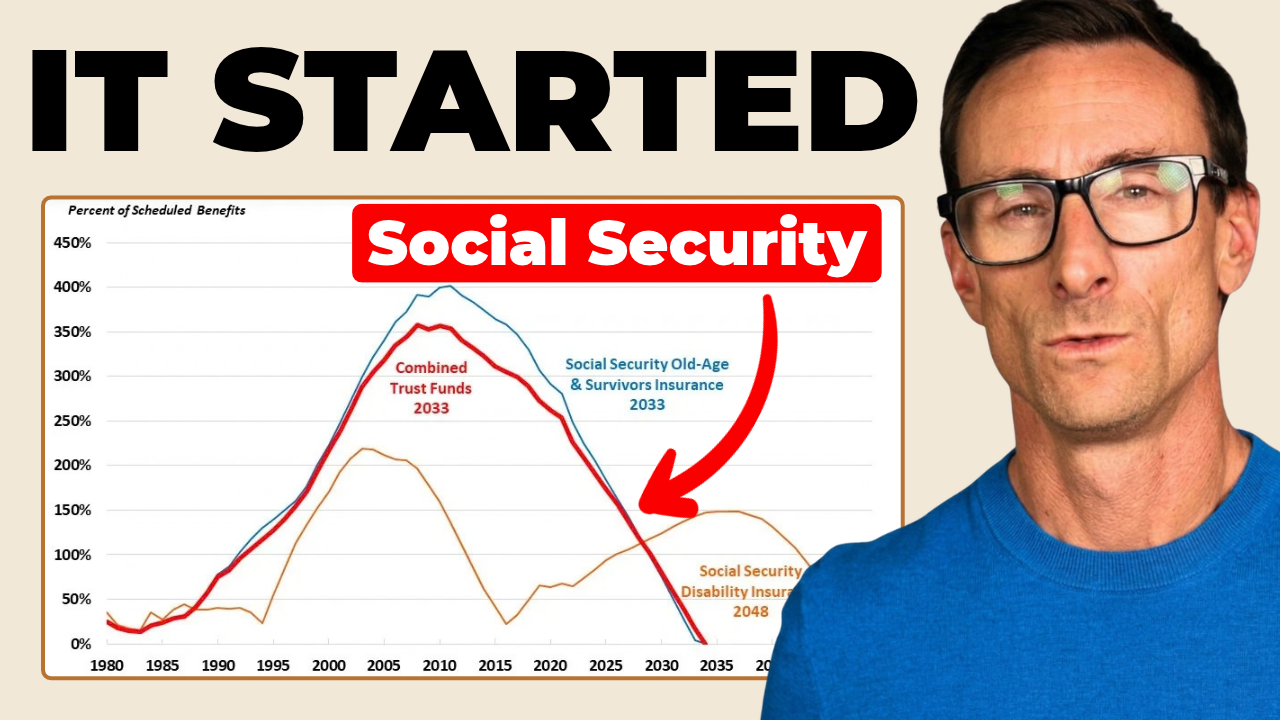
Headlines about Social Security running out of money have picked up again, and the timeline just moved closer. The program’s retirement trust fund is now projected to run dry in late 2032, about six years from now. I’m already seeing people near retirement react in ways that could hurt their plans. Before you change anything, it’s worth understanding what the numbers actually say, how this is likely to get fixed, and what’s worth doing today.
Why Social Security’s Trust Fund Is Running Low
Social Security holds a reserve, known as a trust fund, that pays benefits whenever payroll taxes fall short. For decades, more money came in than went out, so the reserve grew. That changed in 2021. Since then, the program has paid out more each year than it collects, and the difference has come out of the reserve.
The cause is demographic. In 1960, there were 5.1 workers paying in for every person collecting benefits. Today there are about 2.6, and that number keeps falling as baby boomers retire.
This year’s Trustees Report, released in June, projects the retirement trust fund will be depleted in the fourth quarter of 2032. That’s one quarter earlier than last year’s estimate.
2032 or 2034? Why There Are Two Dates
You may also have seen 2034 in the news. Social Security has two legally separate trust funds: one for retirement and survivor benefits, and one for disability. Together they would last until 2034, but combining them would take an act of Congress. If you collect retirement benefits, 2032 is the date that matters.
Is Social Security Running Out of Money?
Not entirely. Payroll taxes keep coming in as long as people keep working. Under current law, though, once the reserve runs dry, that incoming revenue would cover only 78% of scheduled benefits, which works out to a 22% cut. The gap widens slowly over time and reaches 38% by 2100.
The frustration with Congress is earned. Lawmakers have seen this coming for years, and acting early would allow gentler, phased-in changes. Still, I don’t see a reason to overreact.
Social Security Was Built as a Floor
When Franklin Roosevelt signed the law in 1935, he described its purpose as protection against job loss and “poverty-ridden old age.” It was designed as a base layer of income, never the whole retirement. Today it replaces roughly 40% of the average worker’s pre-retirement earnings. What it does exceptionally well is pay you for life and adjust, at least partly, for inflation.
That matters if you’ve saved $2 million, $5 million, or more. For you, Social Security is one part of your income floor, not the whole floor. Your portfolio does most of the work, so a cut is a much smaller share of your plan than the headlines suggest.
Congress Has Fixed Social Security Before
In 1983, the trust fund was only months from being unable to pay full benefits. Acting on a bipartisan commission led by Alan Greenspan, Congress:
- Gradually raised the full retirement age from 65 to 67
- Made up to half of benefits taxable for higher-income retirees, at thresholds that have never been indexed for inflation ($25,000 single, $32,000 married)
- Delayed that year’s cost-of-living increase by six months
- Accelerated a payroll tax increase that was already scheduled
- Brought new federal employees and nonprofit workers into the system
Retirees weren’t spared, and those with more income carried more of the cost. The fix was late and messy, but it worked for decades.
What a Fix Could Look Like This Time
Congress could raise the 12.4% payroll tax or lift the wage cap, which is $184,500 in 2026. It could also raise the retirement age for younger workers, change how cost-of-living increases are calculated, or reduce benefits for higher earners. Covering the gap from general revenue is possible, but it isn’t free. Interest on the national debt already cost about $970 billion in fiscal 2025.
In my view, a full 22% cut with no action at all is the least likely outcome, because it’s the most politically toxic option. What’s more likely is a late, mixed fix, phased in over time and weighted toward higher earners and younger workers.
Four Moves Worth Making Now
1. Run your numbers with a 22% cut. Take a hypothetical couple, David and Sarah, whose expected retirement paycheck is $16,000 a month after taxes. Apply the full cut to their Social Security and their income drops to $14,800. That’s about a 7.5% reduction in total income, not 22%.
2. Use your peak earning years. In 2026, workers 50 and older can add an extra $8,000 to their 401(k), and those aged 60 to 63 can add $11,250 if their plan allows it. If you earned more than $150,000 in wages last year, those catch-up dollars must go in as Roth.
3. Set spending guardrails. Instead of locking in one spending number for 30 years, set upper and lower portfolio markers. Using the same couple:
- They retire with $3.5 million and a $18,900 monthly gross paycheck.
- If the portfolio grows about 24% to $4.35 million, they get a $3,800 monthly raise.
- If it falls about 29% to $2.47 million, they trim $800 a month.
With guardrails in place, a benefit cut becomes an adjustment rather than a crisis.
4. Don’t claim early out of fear. Under current law, a cut would apply to everyone collecting, including people who already claimed. Meanwhile, claiming at 62 instead of 67 shrinks your check by about 30% for life. Base the decision on your health, your other income, and what your plan needs.
The Bottom Line
Social Security isn’t running out of money, but its retirement reserve is running low, and the timeline is closer than it used to be. Social Security is one part of a well-built retirement, not the whole thing. You can’t control when or how Washington acts. You can make sure your plan holds up under several versions of the fix.
The Retirement Recap
Join the 1,000+ other retirees and get weekly articles and videos to help you retire with confidence. Subscribers also gain access to our private monthly client memo.
Seek Professional Guidance
Navigating retirement decisions can be complex. Consulting with a certified financial planner can provide personalized insights and strategies tailored to your unique circumstances. Whether you’re nearing retirement or planning ahead, expert advice can help you optimize your Social Security benefits and achieve greater financial confidence in your retirement years.
This does not constitute an investment recommendation. Investing involves risk. Past performance is no guarantee of future results. Consult your financial advisor for what is appropriate for you. Disclosures: https://onedegreeadvisors.com/disclosure/