

At $7 million, most people already know they have enough to retire. The harder question is whether they’re getting the most out of what they’ve built. Can a portfolio that size really spend $400K a year while staying sustainable for decades? And what does it take to do that without second-guessing every withdrawal?
Here’s how one couple’s plan comes together, covering spending, taxes, investments and family legacy.
Meet Peter and Donna
Peter, 65, sold the electrical company he spent more than three decades building. As part of the buyout, he’s staying on as a consultant through mid-2027 at a $200,000 salary. Donna, 63, works 32 hours a week in health care, earning $75,000. She genuinely enjoys her job.
They live in San Clemente, California, in a $1.7 million home. The remaining $185,000 mortgage is at a 2.7% fixed rate, and they’re happy to keep paying it rather than pay it off early.
Their assets:
- Joint trust brokerage account: $5.6 million, mostly from the business sale, with a high cost basis
- Peter’s IRA: $810,000
- Donna’s IRA: $240,000
- Donna’s Roth IRA: $320,000
- Cash savings: $350,000
Like many people at this level of wealth, they’re hardworking, frugal and practical. Peter still thinks like a small-business owner who once worried about making payroll. Even though they could spend far more, giving themselves permission to enjoy it doesn’t come easily.
What They Wanted, and What Worried Them
Their priorities were clear:
- A sustainable spending plan
- Organized, purposeful investments
- Travel while they’re healthy, including trips with family
- Greater charitable impact
Their concerns were just as clear. Would they have enough income for life, given unknown health care costs? Could they keep taxes under control after a large taxable event? And how do they make good decisions in a life that’s about to look very different?
Can They Really Spend $400K a Year?
They estimated core expenses at $12,500 a month. We planned for $15,000 to give them breathing room. On top of that, they wanted $50,000 a year for travel through Donna’s age 80, plus $30,000 a year for charity. Including the mortgage, that came to about $24,000 a month.
The plan showed they could actually spend $31,500 a month after tax, about $33,700 gross, or roughly $400,000 a year, and remain sustainable over the long term. That $7,500-a-month gap between what they need and what they can spend is their cushion.
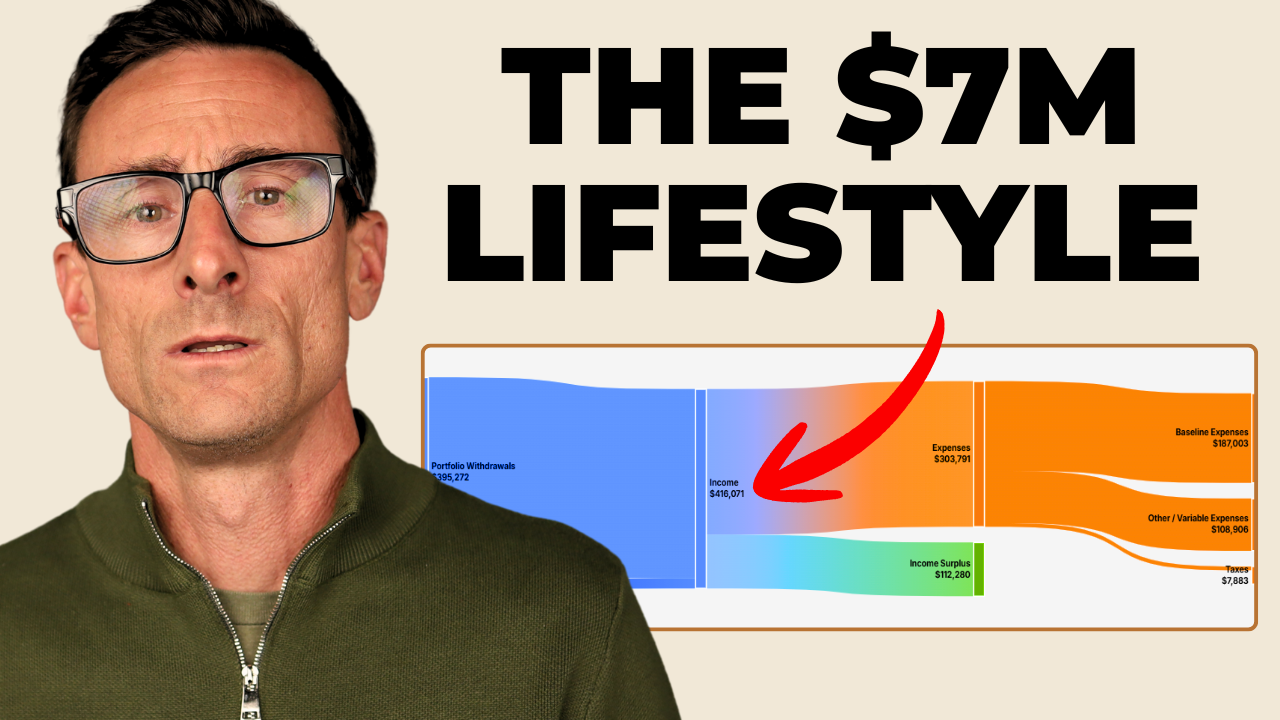
In 2028, their first full year of retirement, the plan supports about $395,000 in portfolio withdrawals. Donna’s Social Security adds about $21,000 in that first partial year. Against roughly $304,000 in planned expenses, that leaves around $112,000 they won’t need to touch.
Guardrails: Knowing When to Spend More
Their portfolio is projected at $7.1 million when both stop working, not counting bank cash. Rather than set one spending number and hope, we use dynamic, risk-based guardrails.
- Starting point: The plan begins with an 80% probability that they’ll underspend their capacity.
- Upper guardrail: If that probability reaches 100%, around a $13.6 million portfolio, they get a meaningful raise.
- Lower guardrail: If the risk of overspending reaches 75%, around $3.7 million, they trim spending.
The bands are adjustable. For example, the raise can trigger at 90% instead of 100%. Cost-of-living increases also happen without hitting a guardrail. The result is that instead of asking “Can we afford this?”, they’ll know when the numbers say yes.
Using the Tax Valley Wisely
Because Peter paid significant tax on the business sale, their brokerage account has a high cost basis. Withdrawals from it generate relatively little taxable income. From 2028 through 2035, they’ll be in a “tax valley,” several years of unusually low taxable income.
For many retirees, that’s prime time for aggressive Roth conversions. For Peter and Donna, the math is different. Two things change it:
- Qualified charitable distributions: After age 70½, they’ll give directly from their IRAs. This helps offset required minimum distributions, which start at 75 for their birth years.
- A donor-advised fund: They give appreciated shares to the fund, avoiding capital gains while generally still claiming a deduction under current itemizing rules.
Converting heavily now would mean prepaying tax on dollars they plan to give away anyway. Instead, we’ll look for small, strategic conversions within the 12% bracket. Those hedge against future tax increases and leave more tax-free dollars for their kids.
Social Security and Health Care
Peter will delay Social Security to 70, at an estimated $4,500 a month. If he passes first, Donna steps into that larger survivor benefit. Donna will claim at 65, at about $2,200 a month. That eases early withdrawals while keeping lifetime benefits strong.
For health care, we built a $500,000 inflation-adjusted long-term care cost directly into their spending plan. It isn’t a separate account, so the $400K figure already accounts for it.
Donna’s employer coverage carries her to Medicare at 65. If you retire earlier, budget for COBRA or private coverage, possibly an Affordable Care Act plan.
A Three-Year War Chest for Downturns
We asked them: how many years of income would you want in conservative investments when stocks fall? Historically, markets have taken two to three years on average to regain a prior peak, though some of the worst downturns took far longer.
Peter and Donna are growth-oriented and chose three years. That’s about $1.1 million in cash and bonds, roughly 16% of the portfolio. The other 84% stays in stocks for long-term growth.
They’ll draw from the taxable account first, then IRAs, and let their Roth grow longest. In normal markets they rebalance. In major downturns they draw from the war chest, so they never have to sell stocks at a 30% discount.
Wisdom Before Wealth
Much of their wealth will eventually pass to their children and grandchildren. Their goal is for it to help, not divide. So before making large gifts, they’ll hold family conversations about values, expectations and the responsibility that comes with inheritance.
The Bottom Line
When we met Peter and Donna, their money sat in old mutual funds and a lot of cash, with no cohesive plan. Now their spending, taxes, investments and family plans work together, and their CPA is on the same page.
If you’re approaching retirement with a portfolio like theirs, the real question isn’t “Do we have enough?” It’s “What is our money actually for?” Answer that first, then build guardrails, tax strategy and an investment structure around it.
The Retirement Recap
Join the 1,000+ other retirees and get weekly articles and videos to help you retire with confidence. Subscribers also gain access to our private monthly client memo.
Seek Professional Guidance
Navigating retirement decisions can be complex. Consulting with a certified financial planner can provide personalized insights and strategies tailored to your unique circumstances. Whether you’re nearing retirement or planning ahead, expert advice can help you optimize your Social Security benefits and achieve greater financial confidence in your retirement years.
This does not constitute an investment recommendation. Investing involves risk. Past performance is no guarantee of future results. Consult your financial advisor for what is appropriate for you. Disclosures: https://onedegreeadvisors.com/disclosure/