

If you have $3 million or more sitting in a 401(k) or IRA, chances are someone has told you to start converting to Roth as fast as possible. It’s become almost reflexive advice in retirement planning circles. But the truth is more nuanced: there are real situations where people shouldn’t do Roth conversions — or at least shouldn’t do them the way, and at the time, they’re currently planning to. Getting the timing wrong can cost more than doing nothing at all.
The Mistake That Feels Responsible But Isn’t
The most common misstep happens to people who are doing everything “right.” You’re a few years from retirement, you’ve read about Roth conversions, and the logic seems sound: get a head start, build a tax-free bucket before you retire.
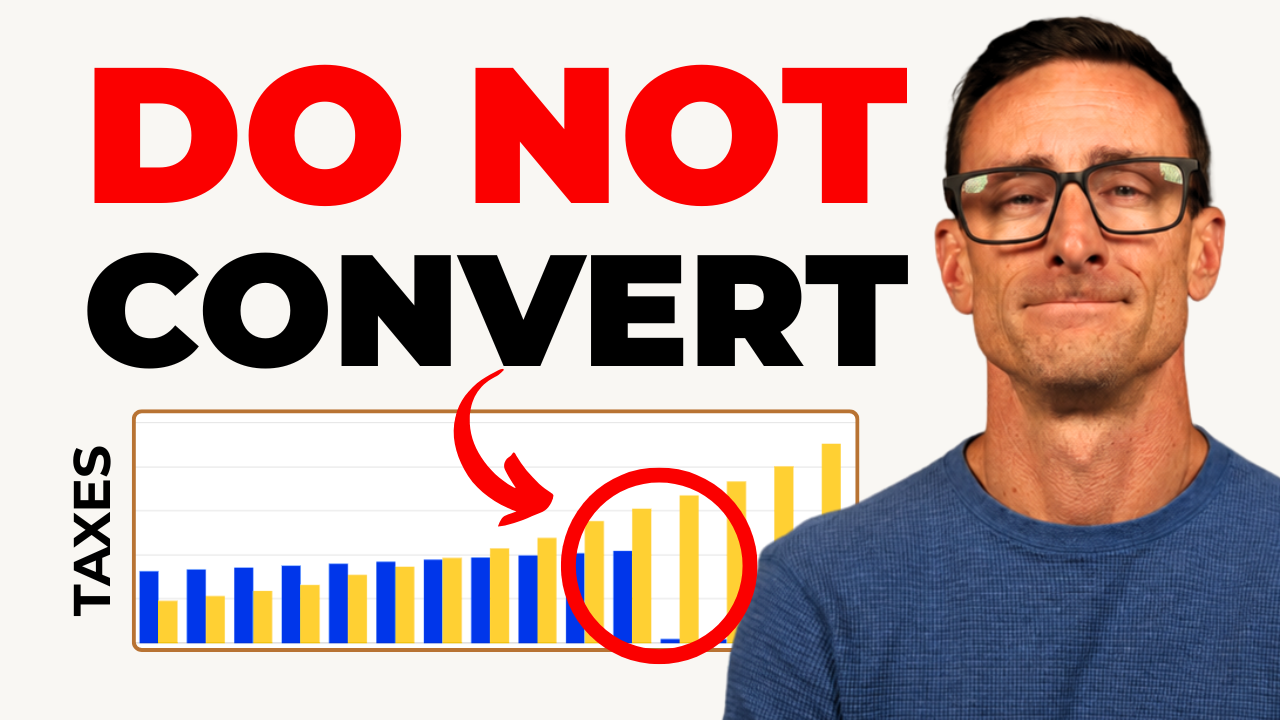
The problem isn’t the strategy — it’s the timing. Every dollar you convert while you’re still working doesn’t get taxed at some blended average rate. It gets stacked on top of your existing income and taxed at your highest marginal bracket. For most people still earning a full salary, that’s not a low number.
Consider a couple bringing in about $288,000 a year in combined W-2 income. A $100,000 Roth conversion done while they’re still working would likely be taxed around 24% or more at the federal level, plus state tax, plus potential surtaxes — pushing the real cost of that conversion close to 33 cents on the dollar or higher.
Now compare that to the year after they retire. Their W-2 income drops to zero, they start drawing from a brokerage account instead, and their taxable income falls dramatically. That same $100,000 conversion might cost 12 to 20 cents on the dollar instead of 33. Do that every year in the wrong window, and the gap compounds into real six-figure damage over time.
The “Tax Valley” — and Why Most Calculators Miss Half the Picture
The stretch of years between when your paycheck stops and when Social Security and required minimum distributions (RMDs) begin is sometimes called the tax valley. It’s often the cheapest window you’ll ever have to convert — but converting before that window opens means voluntarily paying a tax rate you’re about to escape.
Here’s where most Roth conversion calculators fall short: they’re only built to calculate tax. If you’re retiring before 65, a conversion can also hit your health care costs, and that difference isn’t gradual — it’s a cliff.
If you’re drawing mostly principal from a brokerage account in early retirement, your reportable income can stay low enough to qualify for Affordable Care Act subsidies. Layer in a large Roth conversion, and your income can jump straight through the subsidy cliff — not gradually, but entirely, the moment you cross the threshold. A previously manageable health insurance premium can suddenly run thousands of dollars more per year, and that added cost has to be counted as part of what the conversion actually costs you.
There’s a second, delayed version of this same problem: IRMAA, the Medicare premium surcharge. Medicare looks back two years to set your premium, so a large conversion at 63 or 64 doesn’t show up in your mailbox until you’re actually on Medicare — often catching people off guard. Cross the first IRMAA threshold as a married couple, and you’re looking at meaningfully higher Part B and Part D premiums annually, just for being a dollar over the line.
The Other Extreme: Converting Too Much
If all of this makes “just don’t convert” sound like the safer answer, that’s a trap too. Married couples over 65 get a substantial standard deduction — and it resets every single year, whether you use it or not. If you’ve converted everything to Roth by your early 70s, you may have nothing left in a pretax account to draw against that deduction at low or zero tax rates. That’s free tax space, wasted, year after year.
Over-converting also eliminates a tool that becomes available at 70½: the Qualified Charitable Distribution (QCD), which lets you send funds directly from a pretax IRA to charity — up to $111,000 per person in 2026 — without it ever counting as taxable income. It satisfies your RMD and never touches your tax return. But it only works if there’s still money in a pretax account. Convert everything, and that option disappears permanently.
What the RMD Math Actually Looks Like
Leaving a large pretax account completely untouched has its own cost. The IRS uses required minimum distribution tables that don’t ask how much money you actually need. At age 75, the current divisor is 24.6 — meaning a $6.1 million IRA would generate roughly $248,000 in mandatory, fully taxable income in year one alone, regardless of whether you need it.
The Real Answer
The right approach usually isn’t “convert everything” and it isn’t “convert nothing.” It’s converting a deliberate, calculated amount each year inside the tax valley — enough to keep a large pretax balance from becoming an RMD tax bomb later, while watching for the health care cliffs, preserving standard deduction space, and keeping the charitable giving tools intact.
Roth conversions aren’t the enemy. Done at the right time and in the right amounts, they’re one of the most effective tools available in retirement planning. Done reflexively — too early, too aggressively, without running the full picture — they can cost more than they save.
The Retirement Recap
Join the 1,000+ other retirees and get weekly articles and videos to help you retire with confidence. Subscribers also gain access to our private monthly client memo.
Seek Professional Guidance
Navigating retirement decisions can be complex. Consulting with a certified financial planner can provide personalized insights and strategies tailored to your unique circumstances. Whether you’re nearing retirement or planning ahead, expert advice can help you optimize your Social Security benefits and achieve greater financial confidence in your retirement years.
This does not constitute an investment recommendation. Investing involves risk. Past performance is no guarantee of future results. Consult your financial advisor for what is appropriate for you. Disclosures: https://onedegreeadvisors.com/disclosure/