

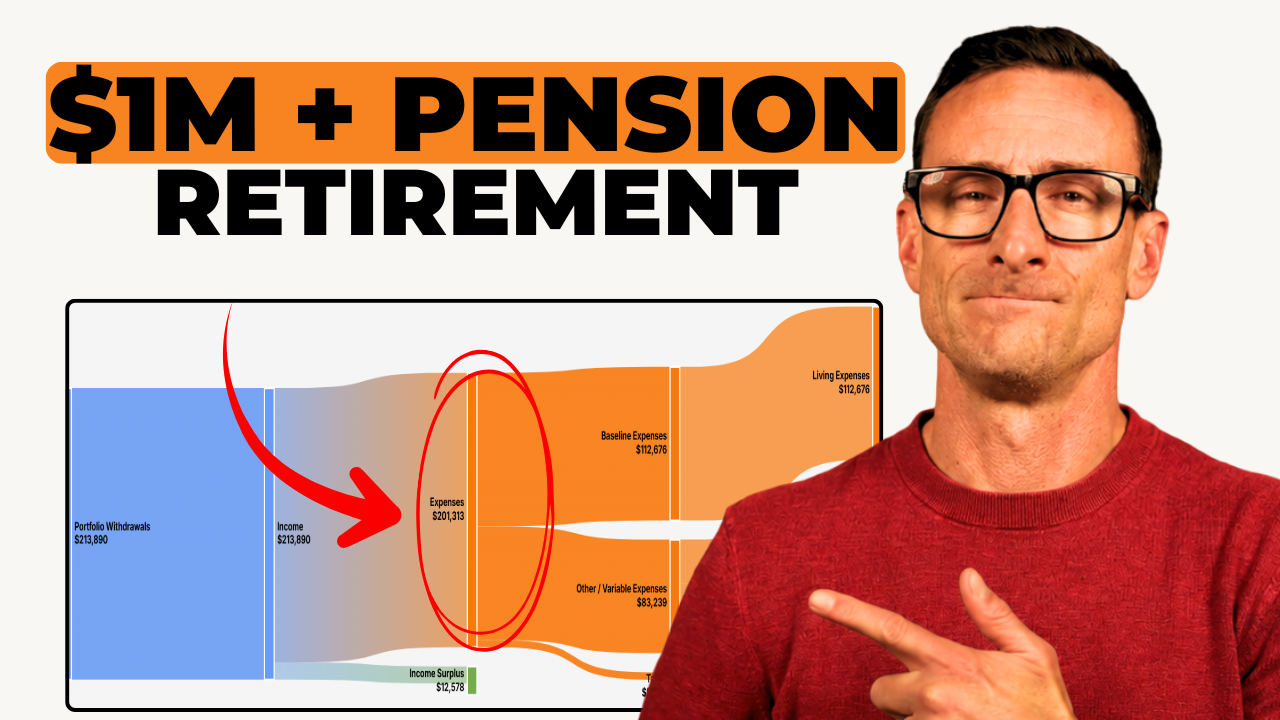
Retiring with both a pension and a retirement portfolio sounds like the easy version of retirement planning. In practice, it’s often the more complicated one. A pension changes how you should invest, shrinks your window for smart tax moves, and can leave a surviving spouse with a tax bill nobody planned for. Coordinating a pension and retirement portfolio the right way means treating them as one connected system instead of two separate accounts, and getting that coordination right can be worth well into six figures over a lifetime.
To see how this plays out, consider a couple we’ll call Tom and Mary. Both are near 62, planning to retire in about a year and a half, with a $1 million portfolio and a pension starting at 65. On paper, that looks like a strong position. It is, but only if four decisions get made in the right order.
The Pension Election: A Choice You Can’t Take Back
Before anything else gets planned, the pension itself has to be claimed, and that decision is permanent.
Tom’s pension offers three options at 65:
A lump sum of $815,000
A single-life monthly payment of $4,700 (stops when he dies)
A 100% joint survivor payment of $4,275 (continues for Mary’s life if Tom dies first)
The way to compare a lump sum against monthly payments is a hurdle rate: the annual return the lump sum would need to earn, invested, to match what the monthly payments provide. For the single-life option, that hurdle rate is 5.67%, assuming Tom lives to 95. For the joint survivor option, it drops to 4.84%, and it comes with the added benefit of protecting Mary for life.
Tom and Mary are projecting roughly 6.5% average returns on their portfolio, comfortably above the 4.84% hurdle. That points toward the lump sum. But the math isn’t universal. A pension with a cost-of-living adjustment, a smaller lump sum, or a higher monthly benefit can flip the answer entirely, which is why this needs to be run on your own numbers, not someone else’s rule of thumb.
There’s also a piece the hurdle rate doesn’t capture: risk. Monthly payments shift longevity risk to the pension provider. The check keeps coming no matter how long you live, but it’s rigid and leaves nothing for heirs beyond a survivor benefit. A lump sum shifts investment risk to you, but it comes with flexibility to adjust income year to year and a balance that can pass to a spouse, kids, or charity.
How the Pension Reshapes the Retirement Portfolio
The pension election isn’t just about the money. It changes how the rest of the retirement portfolio should be invested.
Tom and Mary need about $13,400 a month in the early retirement years, before the pension and Medicare kick in, the highest-demand stretch in the entire plan. As income layers in (the pension at 65, then Social Security at 67 and 70), the burden on the portfolio steps down each time.
Because guaranteed pension income is already covering part of the spending floor, Tom and Mary can hold about 80% of their portfolio in growth assets and 20% in a stable “war chest” of cash and high-quality bonds. Without a pension, that stable portion typically needs to be larger to carry income needs through a rough market on its own.
To manage how much the 80% growth allocation moves around, they use dynamic guardrails: if the portfolio grows to $1.5 million, they can increase spending by $2,400 a month; if it drops to just over $1 million, they pull back by $500 a month until it recovers. Clear thresholds replace guesswork, and because the pension keeps covering core expenses even at the lower guardrail, the adjustment stays manageable.
Social Security Timing Connects to the Pension, Too
Tom’s Social Security benefit at full retirement age is $3,500 a month, growing to $4,340 if he delays to 70. Social Security credits roughly 8% per year for each year of delay past full retirement age. Mary’s full retirement age benefit is $1,800.
Delaying Tom’s claim to 70 does two things at once: it maximizes the survivor benefit Mary would keep if Tom dies first, and it opens up the best years for Roth conversions, since income is lower before that Social Security check starts. Mary, meanwhile, has more flexibility. She could claim earlier than 67 without meaningfully changing their lifetime outcome. That gives the couple a lever to pull if they need income sooner.
One note worth checking if you spent time in public-sector work: the Social Security Fairness Act, signed into law in January 2025, repealed the Windfall Elimination Provision and Government Pension Offset, which had reduced or eliminated Social Security benefits for many public pension holders. If you assumed your benefit was permanently reduced because of a public pension, it’s worth confirming your current status. It may look different now.
The Widow’s Penalty: Where Pension and Retirement Portfolio Planning Really Pays Off
Here’s the scenario that catches most couples off guard. If Tom dies first, Mary keeps the higher of the two Social Security benefits ($4,340) and the survivor pension payment ($4,275), roughly $8,600 a month, or about $103,000 a year, before touching the portfolio. That income barely changes. What changes is the tax treatment: Mary moves from married-filing-jointly to filing single, her standard deduction is roughly cut in half, and every dollar she draws from a pretax account is taxed more heavily than it was before. This is often called the widow’s penalty, and it’s one of the most overlooked risks in pension and retirement portfolio planning.
The main defense is Roth conversions, done deliberately while both spouses are alive and filing jointly. Converting up to the top of the 12% federal bracket each year is projected to save Tom and Mary roughly $181,000 in lifetime taxes and reduce their average tax rate by 2.6%. Because the pension starts taxable income earlier than it would otherwise, the window for these conversions is shorter than in a no-pension retirement, so the planning has to be more deliberate, not less. One added constraint: before Medicare eligibility at 65, Roth conversions can push income high enough to reduce ACA health insurance subsidies, so the exact conversion amount should be reassessed year by year rather than fixed in advance.
Bringing It Together
A pension and $1 million portfolio can be a genuinely strong retirement position, but only when four decisions are made as one connected plan rather than four separate choices: how the pension is claimed, how the portfolio is invested around it, when Social Security is claimed, and how Roth conversions are used to protect the surviving spouse. Change one decision, and it shifts the others.
Every household’s version of this will look different: a different hurdle rate, a wider or narrower tax-conversion window, a different survivor scenario. The framework holds regardless of the exact numbers, and running your own is worth the effort before you make any of these decisions, since several of them can’t be undone once made.
The Retirement Recap
Join the 1,000+ other retirees and get weekly articles and videos to help you retire with confidence. Subscribers also gain access to our private monthly client memo.
Seek Professional Guidance
Navigating retirement decisions can be complex. Consulting with a certified financial planner can provide personalized insights and strategies tailored to your unique circumstances. Whether you’re nearing retirement or planning ahead, expert advice can help you optimize your Social Security benefits and achieve greater financial confidence in your retirement years.
This does not constitute an investment recommendation. Investing involves risk. Past performance is no guarantee of future results. Consult your financial advisor for what is appropriate for you. Disclosures: https://onedegreeadvisors.com/disclosure/