

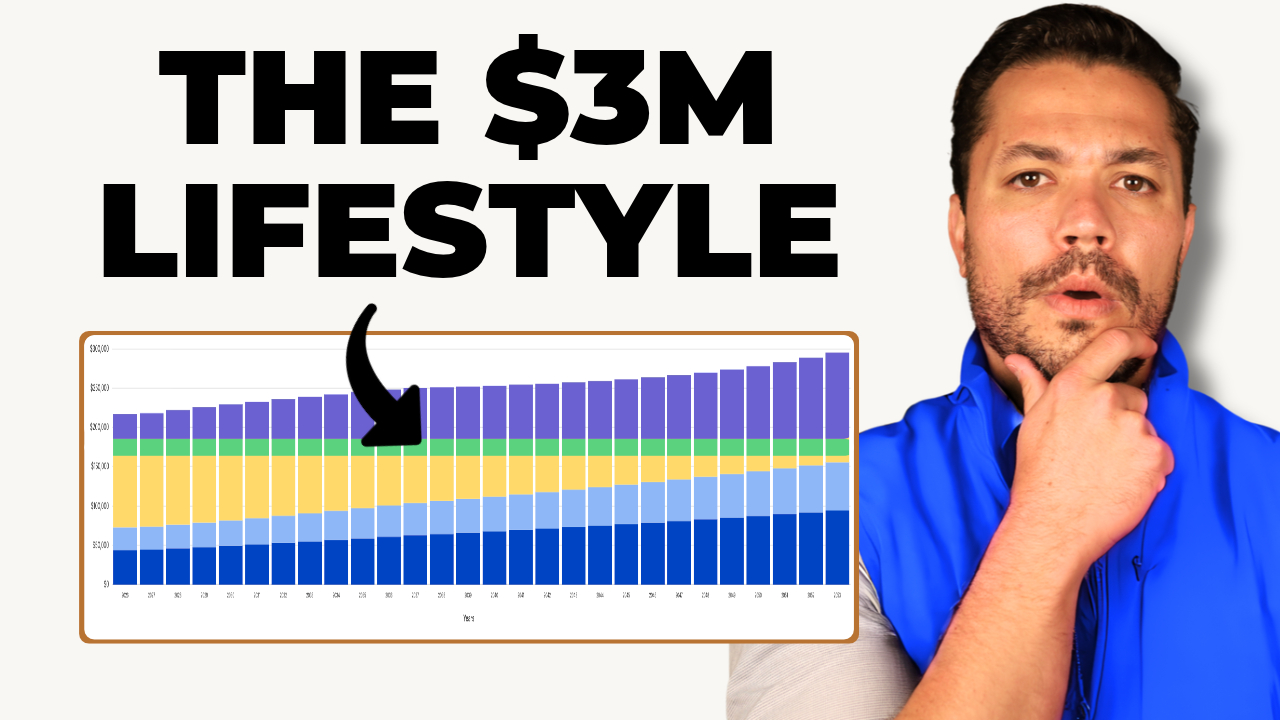
If you’ve built a $3 million portfolio, you probably have a monthly spending number that feels safe. The question is where that number came from. For many retirees, it’s a rule of thumb rather than a real analysis, and it can quietly cost them years of the retirement they worked so hard for.
Consider Don, 66, and Nancy, 64. They believed $12,200 a month was the most they could spend. After a closer look at their income sources, spending patterns, and taxes, the real number turned out to be about $17,200. That’s $5,000 a month they were leaving on the table.
The Hidden Risk of Spending Too Little
Most retirees worry about running out of money. Far fewer worry about the opposite: ending life with far more than they needed while skipping the experiences they valued most.
The 4% rule is a good example. Backtests of a classic 60/40 portfolio show that retirees who held withdrawals to 4% a year, adjusted for inflation, finished with more money than they started with more than half the time.
Why do so many people stick to conservative rules anyway? Usually it’s a scarcity mindset built over decades of saving. Even with a strong portfolio, they fear that a market downturn, a medical event, or an unexpected bill could unravel everything. So they defer spending, just in case.
That caution has a cost. It’s not only about skipped vacations or nicer restaurants. It’s about taking the grandkids to Disney while you still have the energy, and saying yes to opportunities without guilt. That window doesn’t stay open forever.
Inside Don and Nancy’s $3 Million Portfolio
Don and Nancy wanted to retire right away. Their savings were spread across three accounts:
- $1.3 million in a joint brokerage account, about half of it cost basis
- $700,000 in Don’s 401(k)
- $1 million in Nancy’s rollover IRA
Their planned spending looked like this:
- $7,000 a month for core living expenses
- $24,000 a year for travel over the next 15 years, while they’re healthy enough for overseas trips
- $18,000 a year in charitable giving
- $800 a month for one year of health insurance premiums before Nancy reaches Medicare
That adds up to roughly $135,000 a year before taxes, about 4.5% of the portfolio. It fell in line with traditional rules of thumb, so it felt reasonable.
The projections assumed a moderate growth strategy, with returns of 2.3% after inflation for the first decade. That’s an assumption, not a guarantee. Yet even at their original spending level, their lifetime income came out at or above plan in every one of thousands of simulations.
Map Where Your Retirement Paycheck Comes From
Don and Nancy tracked their total spending, but not what was actually coming out of the portfolio. They assumed they’d draw evenly from their accounts. They also weren’t sure how to account for Social Security benefits that wouldn’t start right away.
Once the cash flow was mapped year by year, the picture changed:
- Year one: Nancy would claim Social Security early, and about $9,200 a month would come from the brokerage account.
- Year two onward: Portfolio withdrawals would drop to roughly 2% a year.
Taxes worked in their favor, too. Because of how long-term capital gains and the standard deduction interact, they’d owe almost no federal tax in the first year. Their $12,200 monthly paycheck carried virtually no tax drag.
It was a good plan. But was it a great one?
How a $3 Million Portfolio Supported $17,200 a Month
The breakthrough came from changing the question. Instead of asking “Can we spend this?” the analysis asked “What can we spend?”
Research shows that most retirees spend more early in retirement, less in the middle years, and more again toward the end of life. Building the plan around that pattern, rather than assuming flat spending every year, is what unlocked the higher number.
The projection also accounted for how income shifts over time, including Don’s Social Security starting later and reducing what they needed from the portfolio. Retirement isn’t static, and a plan that only works in year one doesn’t really work at all.
The result: about $17,200 a month. Even at that higher level, projections still showed their income staying at or above plan in 99% of simulations over their lifetime. They stopped asking “Can we afford it?” and started asking “Is this the life we want to live?”
Stress-Testing the Plan Against a Market Crash
A plan that spends more has to survive a downturn. So the higher-spending plan was tested two ways.
First, a 45% portfolio drop. Their income would need to come down, but only by about $600 a month. That’s a minor adjustment, not a lifestyle disruption.
Second, the plan was modeled against some of the worst periods in market history, including the 2008 financial crisis. It held up well. Those years wouldn’t have been stress-free, but Don and Nancy would know exactly when and how to pull back if needed.
This changes the conversation from “What if the market drops?” to “How will we respond?” Having that answer in advance takes emotion out of the decision and makes it easier to stay the course.
The Tax Lever Most Retirees Never Pull
The default approach is to draw from taxable accounts first and leave IRAs for later. That keeps taxes low today but can create a large tax bill down the road. The IRAs keep growing, required minimum distributions (RMDs) eventually spike, and you lose control over how much you owe.
Don and Nancy took a different route. They converted pretax dollars to Roth accounts up to the top of the 12% federal bracket each year. That smoothed their taxable income across retirement and avoided future spikes.
That single decision was projected to cut their lifetime taxes by about $334,000 in inflation-adjusted terms, and to raise their net lifetime income by the same amount. Nothing about it was radical. It was simply proactive tax planning, revisited every year.
The Price of Playing It Safe
Spending less isn’t free. Had Don and Nancy stuck with their original number, the median projection showed them ending life with about $2.5 million in today’s dollars, not counting their home. In some scenarios, they’d have left more than $6 million.
Under the optimized plan, the median projected balance falls to about $1 million, and the best case is roughly $2.5 million.
| Projected ending balance (today’s dollars, excluding home) | Original plan | Optimized plan |
|---|---|---|
| Median scenario | About $2.5 million | About $1 million |
| Upper-end scenarios | More than $6 million | About $2.5 million |
Leaving a large legacy is a worthy goal, and no one should talk you out of it. But it should be a deliberate choice, not a byproduct of fear. Most families want to enjoy time together, share their values, and pass on wisdom before wealth.
Conclusion: Make Your $3 Million Portfolio Work for the Life You Want
Don and Nancy walked in thinking $12,200 a month was their ceiling. They left knowing it was closer to $17,200. The difference didn’t come from taking more risk. It came from better information.
If you’re living off a $3 million portfolio, a few steps can help you find your own number:
- Map your income year by year. Know which accounts fund each year and when Social Security begins.
- Plan for spending that changes. Most retirees spend more early, so your plan should reflect that.
- Decide your downturn response in advance. Know how much you’d cut, and when.
- Treat taxes as a lifetime decision. Roth conversions in lower-income years can reduce taxes over decades.
- Make your legacy intentional. Decide what you want to leave, rather than leaving whatever is left.
Play it smart, but don’t confuse caution with wisdom. True wisdom is using your resources with intention, guided by a plan built on data.
The Bottom Line
Social Security isn’t running out of money, but its retirement reserve is running low, and the timeline is closer than it used to be. Social Security is one part of a well-built retirement, not the whole thing. You can’t control when or how Washington acts. You can make sure your plan holds up under several versions of the fix.
The Retirement Recap
Join the 1,000+ other retirees and get weekly articles and videos to help you retire with confidence. Subscribers also gain access to our private monthly client memo.
Seek Professional Guidance
Navigating retirement decisions can be complex. Consulting with a certified financial planner can provide personalized insights and strategies tailored to your unique circumstances. Whether you’re nearing retirement or planning ahead, expert advice can help you optimize your Social Security benefits and achieve greater financial confidence in your retirement years.
This does not constitute an investment recommendation. Investing involves risk. Past performance is no guarantee of future results. Consult your financial advisor for what is appropriate for you. Disclosures: https://onedegreeadvisors.com/disclosure/